
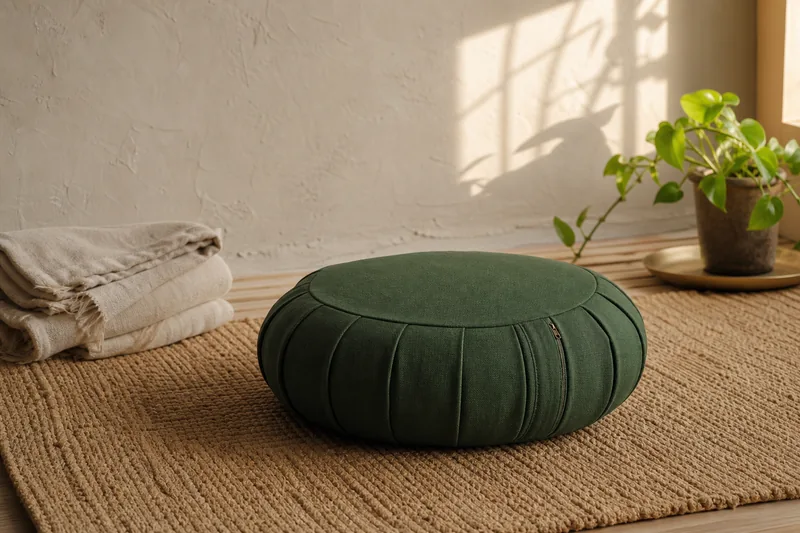
A zafu should lift the hips without feeling like a rigid block. Buckwheat hulls work well because the loose pieces move while you shape the seat and settle against one another under weight. You can remove fill to lower the cushion or add it back when the fabric relaxes.
There is no single correct number of pounds for every zafu. Diameter, finished height, sidewall construction, pleats, crescent versus round shape, fabric tension, and preferred posture all change capacity. The practical approach is to estimate, fill gradually, and stop when the cushion supports your position without forcing it.
Calculator-based starting weights
Prairie Fill's fill calculator uses an approximate density of 10.5 lb per cubic foot and a 0.78 shape factor for a zafu. For the calculator's 14 × 14 × 5 inch preset, that produces about 4.6 lb at medium firmness and 5.5 lb at firm. A 6 lb pack therefore gives enough to build one typical round zafu and keep a small adjustment reserve.
| Cushion | Medium estimate | Firm estimate | Practical note |
|---|---|---|---|
| 14-inch round × 5-inch height | 4.6 lb | 5.5 lb | One 6 lb pack is a straightforward start |
| 16-inch round × 5-inch height | 6.1 lb | 7.2 lb | An 8 lb pack leaves adjustment fill |
| Crescent zafu | Often starts around 4 lb | Often starts around 5 lb | Pattern volume varies; fill and weigh one |
The 16-inch figures use the same density, height, shape factor, and firmness multipliers as the calculator. The crescent range is a planning starting point rather than a calculator preset because crescent patterns vary substantially. If your pattern maker supplies a fill weight, use that first.
Choose height before choosing firmness
Adding hulls changes both firmness and seat height. If your hips need more elevation, a taller pattern or more fill may help; if the cushion already sits too high, packing it harder is unlikely to solve the problem. Test on the floor surface and mat you actually use because a soft rug changes how the base feels.
Sit long enough to notice whether the front edge presses into the thighs, the pelvis feels unstable, or the cushion flattens more than expected. Remove or add about a cup at a time. Large adjustments make it difficult to tell which change improved the position.
Round versus crescent zafu
A round zafu distributes fill around a central seat and is easy to rotate. Pleated sidewalls can create more usable volume than a flat cylinder with the same headline diameter. A crescent supports the hips while leaving more open space for the heels or ankles, but two crescent patterns with the same width may hold very different amounts.
For either shape, a separate inner liner is worth the effort. The outer cover can then be removed for cleaning while the hulls stay contained. Use a strong zipper with a protected pull, and inspect seams before filling. Loose hulls are small enough to escape through a weak closure.
How to fill without making a mess
- Place the empty liner inside a wide clean tote or on a drop cloth.
- Use a scoop or wide-mouth funnel rather than pouring from shoulder height.
- Add roughly three-quarters of the estimate, close the zipper, and shape the seat.
- Add smaller amounts until the cushion reaches the intended height and stability.
- Weigh the successful cushion and write the result down before making more.
Do not fill over an open floor drain, near a fan, or beside moisture. Close the bulk bag after each scoop. If you are producing several matching cushions, complete and test one prototype before multiplying its final fill weight.
Adjusting after the cushion settles
Fabric relaxes and hulls polish with use, so a zafu may feel lower after the first weeks. That does not automatically mean all the fill needs replacing. Open the liner over a tote, redistribute the existing hulls, and add a small amount from the reserve. If the seat is too hard, remove fill and store it dry in the resealable bag.
Replace hulls that become soaked, musty, contaminated, or heavily crushed. Never wash the fill. Our buckwheat pillow care guide explains how to empty and clean a fabric cover while keeping hulls dry.
Planning multiple meditation cushions
Multiply the tested final weight, not the original guess. Four 14-inch medium zafu are about 18.6 lb by calculator math, but pattern and maker preference can move the real number. Ten are about 46.4 lb. For studio quantities, record the empty liner weight and final filled weight, then use our bulk hull planning guide for storage, quality checks, and supplier-fit questions.