
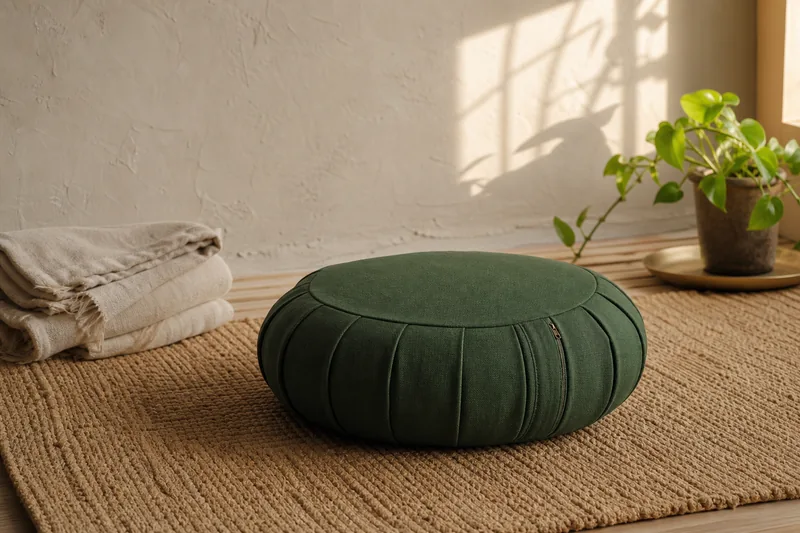
Buckwheat hulls, millet hulls, foam, and polyester fiber can all make useful pillows, but they do not behave alike. Loose hull fill can be moved and removed. A foam core has a set shape. Poly-fill gives a soft, familiar loft. Millet is often chosen by people who want a natural loose fill with a smoother, quieter feel than buckwheat.
This guide separates practical observations from stronger claims. Pillow research is limited, and preference matters: a field study of common pillow types found no single material that guaranteed comfort or good sleep for everyone. A fill that feels wonderfully stable to one person can feel too firm, noisy, or heavy to another.
Quick comparison
| Factor | Buckwheat hulls | Millet hulls | Foam | Poly-fill |
|---|---|---|---|---|
| Feel | Firm, textured, moldable | Smoother, more fluid, usually softer | Resilient or slow-response, formulation-dependent | Soft, springy, familiar |
| Sound | Audible dry rustle when moved | Usually quieter, still not silent | Nearly silent | Nearly silent |
| Air spaces | Large gaps between rigid husks | Smaller particles and smaller gaps | Depends on cell structure, perforation, and cover | Airy at first; loft changes with compression |
| Weight | Heavy compared with fiber fill | Still a loose agricultural fill; finished weight varies | Varies widely by density and size | Usually the lightest option here |
| Adjustability | Easy to add or remove through a zippered liner | Also adjustable in a suitable liner | Fixed core; shredded foam is more adjustable | Add or remove fiber, but even distribution takes work |
| Care | Keep fill dry; wash the empty cover | Keep fill dry; follow seller instructions | Follow the foam maker's care limits | Some products are washable; follow the label |
| Best use | Firm adjustable pillows, zafu, cushions, positioning | Quieter natural pillows with a softer shifting feel | People wanting a familiar fixed shape | Light, soft pillows and craft stuffing |
What these fills actually are
Buckwheat hulls are not seed or grain. They are the dark outer husks removed from the edible groat during milling. The USDA describes groats as kernels with the inedible black hull removed. Good pillow fill should therefore look like small, papery, angular husks—not tan groats, bird seed, or flour. Prairie Fill mechanically separates, air-cleans, and screens its hulls to reduce fines and very small fragments.
Millet-hull fill is also a milling byproduct, but the pieces sold for pillows are smaller and move differently. Published head-to-head pillow research is sparse, so claims about millet being “better” should be treated as preference, not settled science. In practical use, people commonly describe millet fill as smoother and quieter, with less of buckwheat's distinctly locked-in texture.
Foam is a broad category. Solid polyurethane, memory foam, latex foam, and shredded foam do not share one feel. “Foam sleeps hot” is too broad to be a reliable rule because density, cell structure, perforation, pillow shape, and cover fabric all change the result. Poly-fill is usually polyester fiber arranged to trap air and create loft; it is light and soft but does not hold a hand-shaped contour the way interlocking hulls can.
Feel and support: stable is not the same as soft
Buckwheat hulls slide while you shape the pillow, then press against one another under weight. That produces a stable hollow for the head or a grounded seat in a meditation cushion. You control loft by removing fill, which can be more useful than choosing between “low” and “high” fixed pillows. It also means a new, overfilled hull pillow can feel uncomfortably hard until adjusted.
A small study presented in 2023 found buckwheat-skin pillows provided adequate neck support and a larger contact area, while memory foam and latex distributed pressure more evenly in that test. That is a useful reminder, not a promise of pain relief. Pillow height, body size, sleep position, cover construction, and personal comfort all matter. If you need a medical or post-operative support, ask a qualified clinician rather than relying on a fill comparison.
Millet is the honest alternative when you like an adjustable natural fill but dislike buckwheat's firm texture. Foam can be a better choice when you want a predictable contour and no shifting particles. Poly-fill is often better for a light guest pillow, decorative cushion, stuffed toy, or craft where softness matters more than a stable contour.
Sound, airflow, and temperature
Buckwheat hulls make a dry-leaf rustle when you reshape them. Most of the sound happens during movement; it is not an electronic hum or continuous noise. Some people stop noticing it, while light sleepers may never like it. Millet usually produces a finer, softer sound, but it is not truly silent. Foam and poly-fill are the clear choices if any particle noise is unacceptable.
The open spaces between buckwheat husks allow air to move through the fill when the pillow is shifted or compressed. That construction is why many people choose hull fill for a less enveloping feel. We still avoid guaranteed “cooling” claims: room temperature, pillowcase fabric, protector layers, humidity, and the sleeper have a large effect. A densely packed hull pillow or impermeable protector can undermine the benefit of open fill.
Weight, care, lifespan, and cost
A full-size buckwheat pillow is noticeably heavy. That helps a cushion stay put, but it can be inconvenient for travel, children, or anyone who regularly moves bedding. Millet pillows are also filled with agricultural material and may require substantial fill to maintain loft. Foam weight varies; poly-fill is normally much lighter.
Keep any loose hull fill dry. Empty it before washing the cover or liner, and replace fill that becomes soaked, musty, or badly crushed. There is no evidence-based universal replacement date. Inspect condition instead: useful hulls remain dry, springy, and mostly intact; old fill may become polished, flattened, or increasingly powdery. Foam and fiber also age differently by formulation and use, so manufacturer care and replacement guidance wins over a generic timetable.
Price comparisons should use the finished project, not a pound-to-pound shortcut. Hull fills may require several pounds, foam is sold by core or volume, and poly-fill is extremely light. Include the cost of a strong zippered liner, shipping, spare fill, and the likelihood that you will adjust or replace material later.
Which fill is the better fit?
Choose buckwheat hulls if…
You want firm, shapeable support; you value a refillable pillow; a heavier pillow is acceptable; and a natural rustle does not bother you. Hulls also work well for zafu, bolsters, positioning cushions, draft stoppers, and upholstery experiments where controlled loose fill is useful.
Choose millet hulls if…
You want an adjustable agricultural fill but prefer a smoother, quieter, less locked-in feel. Buy a small quantity or a finished pillow with a return policy first, because millet and buckwheat preferences are highly personal.
Choose foam or poly-fill if…
You need near silence, low weight, a familiar soft feel, or a fixed manufactured contour. Foam may suit people who dislike particles moving under the cover. Poly-fill is often the practical value choice for lightweight decorative and craft uses.
Allergy and cleanliness questions
Buckwheat hulls are a natural agricultural material, and cleaning does not make them medically hypoallergenic. A published study found higher endotoxin levels on the tested buckwheat pillows than on synthetic pillows; that study does not evaluate Prairie Fill products, but it supports careful, non-absolute allergy language. People with buckwheat, dust, asthma, or bedding-material concerns should consult a qualified healthcare professional and may reasonably prefer a synthetic fill.
Research and definitions
- USDA FGIS: Inspection of Buckwheat — distinction between the black hull and the edible groat.
- Gordon & Grimmer-Somers: pillow comfort and sleep-quality field study — pillow performance and preference vary.
- 2023 pillow material and pressure study abstract — measured differences among buckwheat skin, foam, latex, fiber, and inflatable pillows.
- Endotoxin and house-dust-mite allergen study — reason to avoid unsupported hypoallergenic claims.