
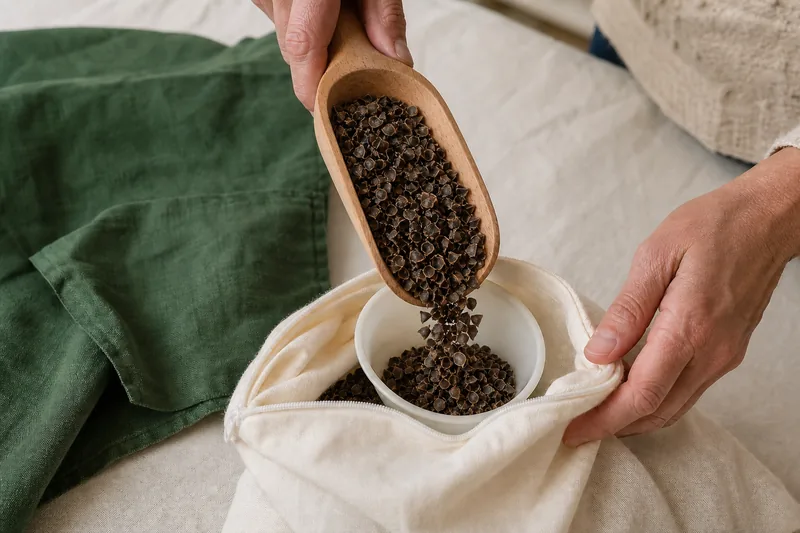
“Bulk” can mean four pillows for a small studio, ten zafu for a meditation room, or hundreds of pounds for a manufacturer. Those projects should not receive the same advice. Prairie Fill currently sells resealable 6 lb and 8 lb packs at the listed website prices; we do not publish a separate bulk-discount schedule. This guide helps you decide how much fill the project is likely to use and when our parcel-size packs are—or are not—the practical route.
The most important first step is estimating pounds. Buckwheat hulls are light individually but occupy irregular space, and a finished cushion's firmness changes how densely they sit. Counting covers without considering dimensions can leave you far short or with more fill than you can store.
Start with dimensions, count, and firmness
Prairie Fill's fill calculator uses an approximate density of 10.5 lb per cubic foot. It multiplies width, length, and loft, then applies a shape factor because a soft pillow or round cushion is not a rigid rectangular box. The medium firmness setting is the baseline; soft is 82% of that estimate and firm is 118%.
That math is transparent on purpose. A 20 × 26 × 2.3 inch standard pillow at the calculator's 0.90 pillow shape factor is about 6.5 lb at medium firmness. Ten identical covers are about 65.4 lb—not “ten bags,” because bag size and pillow size are different units. A 14-inch zafu at the 0.78 zafu factor is about 4.6 lb medium or 5.5 lb firm.
Patterns, seam allowance, fabric stiffness, chambers, and personal feel can move the result. Treat the number as a purchasing estimate, fill one prototype before a production run, and keep a little adjustment room. If you are replacing fill, weigh the dry fill removed from a successful existing piece; that can be more useful than geometry alone.
Calculator-consistent planning table
These figures use the same dimensions, 10.5 lb/ft³ density, shape factors, and medium firmness as the calculator. They are not guaranteed finished weights. Use the calculator for custom dimensions and its soft/firm controls.
| Project | 1 item | 2 items | 4 items | 10 items |
|---|---|---|---|---|
| Standard pillow | 6.5 lb | 13.1 lb | 26.2 lb | 65.4 lb |
| Queen pillow | 7.9 lb | 15.8 lb | 31.5 lb | 78.8 lb |
| King pillow | 9.8 lb | 19.7 lb | 39.4 lb | 98.4 lb |
| 14-inch zafu | 4.6 lb | 9.3 lb | 18.6 lb | 46.4 lb |
| 24-inch floor pouf | 15.4 lb | 30.8 lb | 61.6 lb | 154.0 lb |
Turn estimated pounds into 6 lb and 8 lb packs
Our current choices are the 6 lb pack for $34.99 and the 8 lb pack for $44.99, with shipping to the lower 48 states except North Dakota included at checkout. The calculator searches combinations and favors the least extra fill first, then the fewest packs, then cost. That means the recommendation may mix sizes instead of simply dividing by eight.
Extra hulls are not necessarily waste. Store them dry in the resealable bag and use them to restore loft after a pillow settles, adjust a second project, or replace a small spill. But do not buy a large cushion's full calculated volume without checking that the cover has a secure liner and fill opening. Loose hulls find small gaps quickly.
Prototype before repeating
For a classroom, studio, shop, or lodging project, finish one representative item. Record the empty-cover weight, final filled weight, firmness notes, and how much fill remained. Multiply the successful fill weight by the remaining count. This simple production record is more reliable than assuming every “standard” cover holds the same amount.
What to look for in bulk buckwheat hull fill
First, confirm the material is hull—not edible groats or whole seed. Buckwheat hulls are small, dark-brown, papery, three-winged husks. Color and size vary because this is an agricultural material, but a bag should not look like tan kernels or ground flour.
Ask how the fill is separated and cleaned. Prairie Fill hulls are mechanically separated, air-cleaned, and screened through a sieve to reduce fines and very small fragments. “Reduce” is the honest verb: natural field dust and small pieces may still be present, and no agricultural fill should be advertised as sterile or universally hypoallergenic.
For a large order, examine intact-hull percentage, dust, odor, dryness, and consistency between bags. A few broken pieces are normal. Wetness, musty odor, visible contamination, or a bag dominated by powder is a reason to stop. If your project has a formal material specification, test a representative quantity before approving the full run.
How to store multiple bags
Keep hulls indoors in a clean, dry place, away from floor moisture, leaking walls, and strong odors. Leave unopened fill in its packaging until needed. After opening, close the resealable bag and consider a lidded secondary bin for production areas. Label partial bags with the date opened and project name so fill is not mixed accidentally.
Do not wash the hulls. Wash only an empty cover or liner according to its maker's directions, and refill only when every layer is fully dry. If loose hulls become soaked, musty, or clumped, replacement is safer than trying to rescue material for bedding. Our buckwheat pillow washing guide walks through the transfer process.
Plan the work area before opening many bags: use a wide clean tote, scoop, funnel, drop cloth, and a vacuum reserved for dry cleanup. Minimize fans and cross-drafts. Close each liner immediately after filling and inspect the zipper and seams before moving the piece.
When Prairie Fill is—and is not—the right supplier
Prairie Fill is a small family business packing in Thompson, North Dakota. Our 6 lb and 8 lb parcel-size bags are practical for DIY makers, refill work, prototypes, small studios, and projects that benefit from resealable units. They are also straightforward when you need to mix sizes around a calculator estimate.
A larger industrial supplier may fit better when you need pallet quantities, recurring production contracts, freight appointments, custom bag weights, certificates tied to a manufacturing specification, or the lowest possible per-pound logistics at very high volume. We would rather say that plainly than accept an order that is awkward for both sides. Contact us with total pounds, deadline, destination, and bag-size needs; we will tell you honestly whether our current pack model is practical.
Bulk-order planning checklist
- Measure one actual cover or pattern
- Choose soft, medium, or firm
- Calculate pounds per item
- Build and weigh one prototype
- Multiply by the remaining count
- Plan a small adjustment reserve
- Confirm dry storage space
- Share deadline and destination